Professional Certificate in Artificial Intelligence & Machine Learning – 12 Month Course
Professional Certificate in Artificial Intelligence & Machine Learning
Build a strong foundation in Artificial Intelligence, Python, Machine Learning, Deep Learning, Natural Language Processing, Generative AI and Computer Vision through a structured 12-month integrated programme.
Artificial Intelligence is transforming the way businesses, industries and people work. From intelligent chatbots and recommendation systems to predictive analytics, automation, computer vision and Generative AI, artificial intelligence is becoming an important part of modern technology.
Gyan Eduversity’s Professional Certificate in Artificial Intelligence & Machine Learning is designed as a structured 12-month programme that takes learners from foundational concepts to practical applications of AI and Machine Learning.
Professional Certificate in Artificial Intelligence & Machine Learning
The programme combines programming, data handling, machine learning, deep learning, Natural Language Processing, Generative AI and Computer Vision into a progressive learning pathway.
Course Overview
- Duration: 12 Months
- Programme: Professional Certificate
- Focus: Artificial Intelligence & Machine Learning
- Learning Approach: Conceptual + Practical Learning
- Level: Foundation to Intermediate
- Suitable For: Students, graduates, learners and aspiring technology professionals
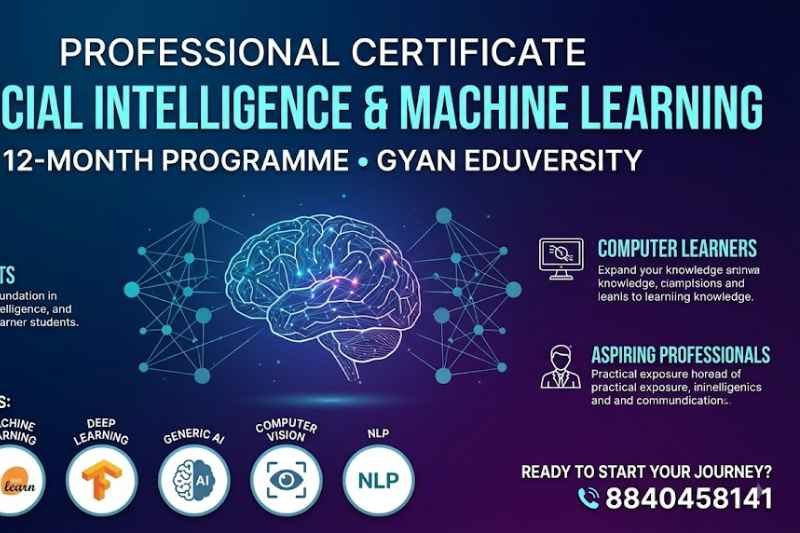
Who Can Learn Artificial Intelligence?
The programme is designed for learners who want to understand modern Artificial Intelligence and develop practical knowledge of AI and Machine Learning.
Students
Build a strong foundation in AI and emerging technologies alongside your academic journey.
Computer Learners
Expand your programming and technology knowledge into the rapidly growing field of AI.
Aspiring Professionals
Develop practical exposure to AI, Machine Learning and Generative AI concepts.
12-Month Artificial Intelligence & Machine Learning Syllabus
The curriculum is organised into 12 progressive modules, beginning with Artificial Intelligence fundamentals and programming and gradually moving towards Machine Learning, Deep Learning, Generative AI, Computer Vision and practical AI applications.
Foundations of Artificial Intelligence
- Introduction to Artificial Intelligence
- Evolution and Applications of AI
- AI, Machine Learning and Deep Learning
- Generative AI: Introduction and Applications
- AI Problem-Solving Methodology
- AI Project Cycle
- Problem Scoping and Goal Definition
- Data Acquisition and Exploration
- AI Modelling and Evaluation
- Introduction to Responsible AI
Python Programming for Artificial Intelligence
- Introduction to Python Programming
- Variables, Data Types and Operators
- Conditional Statements and Control Flow
- Loops and Iterations
- Strings and Collections
- Lists, Tuples, Sets and Dictionaries
- Functions and Modules
- File Handling
- Exception Handling
- Introduction to Object-Oriented Programming
- Python Libraries for AI and Data Science
Data Handling & Processing
- Fundamentals of Data and Datasets
- Structured, Semi-Structured and Unstructured Data
- Data Collection and Acquisition
- Data Preparation and Preprocessing
- Introduction to NumPy
- Introduction to Pandas
- DataFrames and Data Manipulation
- Data Filtering, Sorting and Aggregation
- Data Integration and Transformation
- Preparing Data for AI/ML Models
Data Analysis & Visualisation
- Fundamentals of Data Analysis
- Descriptive Statistics
- Mean, Median and Mode
- Variance and Standard Deviation
- Probability Fundamentals
- Correlation and Relationships in Data
- Introduction to Linear Algebra for AI
- Data Visualisation Principles
- Charts, Graphs and Histograms
- Scatter Plots and Heatmaps
- Exploratory Data Analysis
- Introduction to Matplotlib and Seaborn
Data Cleaning & Feature Engineering
- Importance of Data Quality
- Missing Data and Data Imputation
- Duplicate and Inconsistent Data
- Handling Noisy and Dirty Data
- Data Normalisation
- Standardisation and Z-Score
- Feature Scaling
- Outlier Detection and Treatment
- Feature Selection
- Feature Engineering
- Preparing High-Quality Data for Machine Learning
Machine Learning Fundamentals
- Introduction to Machine Learning
- Machine Learning Workflow
- Supervised Learning
- Unsupervised Learning
- Reinforcement Learning
- Training, Validation and Testing Data
- Features and Target Variables
- Model Training and Prediction
- Model Evaluation
- Overfitting and Underfitting
- Introduction to Scikit-learn
Machine Learning Algorithms & Predictive Modelling
- Regression and Classification
- Simple and Multiple Linear Regression
- Logistic Regression
- Decision Trees
- Random Forest
- K-Nearest Neighbours
- Introduction to Support Vector Machines
- Confusion Matrix
- Accuracy, Precision, Recall and F1 Score
- Cross-Validation
- Model Comparison and Selection
Natural Language Processing & Conversational AI
- Introduction to Natural Language Processing
- Applications of NLP
- Text Data and Preprocessing
- Tokenisation
- Stop Words
- Stemming and Lemmatization
- Bag-of-Words and TF-IDF
- Text Classification
- Sentiment Analysis
- Named Entity Recognition
- Text Summarisation
- Spam Detection
- Introduction to Chatbots and Conversational AI
Neural Networks & Deep Learning
- Introduction to Deep Learning
- Machine Learning vs Deep Learning
- Fundamentals of Artificial Neural Networks
- Artificial Neurons and Perceptrons
- Neural Network Architecture
- Input, Hidden and Output Layers
- Activation Functions
- Forward Propagation
- Backpropagation
- Loss Functions and Optimisation
- Training, Validation and Testing
- Introduction to TensorFlow and Keras
- MNIST and Basic Neural Network Applications
Generative AI & Large Language Models
- Fundamentals of Generative AI
- Generative AI vs Traditional AI
- Generative AI Applications
- Large Language Models (LLMs)
- Tokens and Context
- Embeddings: Fundamentals
- Transformers: Introduction
- Prompt Engineering
- Prompt Design Techniques
- Zero-Shot and Few-Shot Prompting
- AI-Powered Content and Productivity Applications
- Conversational AI
- Introduction to Retrieval-Augmented Generation (RAG)
- AI Hallucinations, Limitations and Responsible Usage
Computer Vision & Image Intelligence
- Introduction to Computer Vision
- Digital Images and Image Representation
- Image Processing Fundamentals
- Image Classification
- Image Recognition
- Object Detection
- Object Tracking
- Colour Detection
- Face Detection and Recognition
- Introduction to Image Segmentation
- Introduction to OpenCV
- Real-World Computer Vision Applications
- Responsible Use of Computer Vision Technologies
AI Applications, Ethics & Capstone Project
- AI Applications Across Industries
- AI in Healthcare
- AI in Education
- AI in Finance
- AI in Business and Marketing
- AI in Manufacturing
- AI in Agriculture
- AI Ethics and Responsible AI
- Bias, Fairness and Transparency
- Data Privacy and Security
- AI Model Evaluation and Deployment: Introduction
- AI Career Pathways and Emerging Opportunities
- Capstone Project Planning and Development
- Final Artificial Intelligence & Machine Learning Capstone Project
- Project Presentation and Evaluation
Tools & Technologies Covered
Learners are introduced to commonly used programming, data analysis, machine learning, deep learning and AI development tools throughout the programme.
What Will You Learn?
- Understand the fundamentals of Artificial Intelligence and Machine Learning.
- Develop a foundation in Python programming for AI and data applications.
- Work with datasets and perform data preparation and analysis.
- Build an understanding of Machine Learning models and algorithms.
- Explore Natural Language Processing and conversational AI.
- Understand neural networks and Deep Learning.
- Explore Generative AI and Large Language Models.
- Understand fundamental Computer Vision techniques.
- Learn about responsible and ethical use of Artificial Intelligence.
- Complete a final AI and Machine Learning capstone project.
Why Learn Artificial Intelligence with Gyan Eduversity?
Structured Learning
A progressive 12-month curriculum designed to take learners from fundamentals to advanced AI concepts.
Modern AI Topics
Explore Machine Learning, Deep Learning, NLP, Generative AI, LLMs and Computer Vision.
Capstone Project
Complete a final AI and Machine Learning project to bring together the concepts covered during the programme.
Career Pathways in Artificial Intelligence
Artificial Intelligence is used across multiple industries and continues to create new technology-focused roles and opportunities. Depending on their education, skills and experience, learners may explore pathways related to:
- Artificial Intelligence
- Machine Learning
- Data Analysis
- Python Development
- AI Application Development
- Natural Language Processing
- Computer Vision
- Generative AI
- AI-assisted Business and Technology Roles
Ready to Start Your AI Journey?
Build your understanding of Artificial Intelligence and Machine Learning with a structured 12-month programme from Gyan Eduversity.